





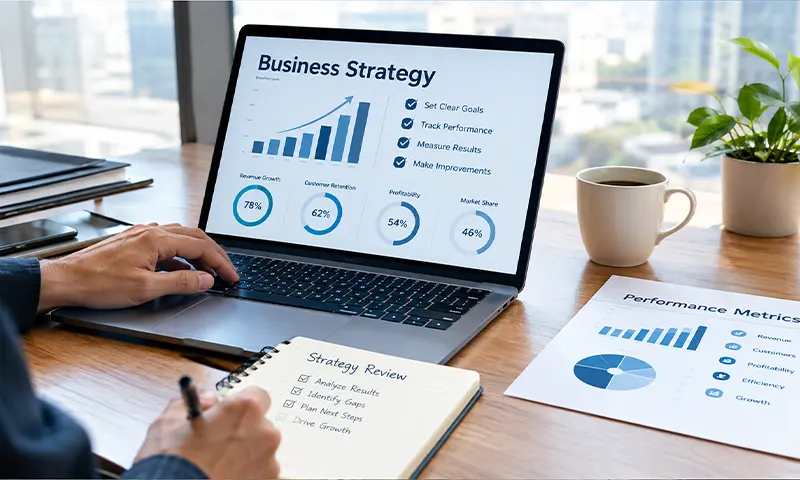
Measure the Success of Your Business Strategy
Measuring the success of a business strategy begins with clearly defined goals. A strategy cannot be evaluated properly if the business does not know what it is trying to achieve. Goals may include increasing revenue, improving customer retention, entering new markets, reducing operating costs, or strengthening brand awareness. Clear and measurable objectives give business leaders something specific to track and make it easier to determine whether the strategy is producing meaningful results.
Track Revenue and Profit Growth
Revenue growth is one of the most straightforward ways to evaluate business performance. Compare current sales with previous periods to identify whether revenue is moving in the desired direction. However, revenue alone does not tell the complete story. A business may generate higher sales while experiencing rising costs and lower profits. For this reason, businesses should also monitor profit margins, operating expenses, and overall profitability when evaluating their strategic performance.
Measure Customer Acquisition
A successful strategy should help a company attract the right customers efficiently. Track metrics such as the number of new customers, customer acquisition cost, conversion rates, and lead quality. If a marketing or sales strategy is bringing in more customers without dramatically increasing acquisition costs, it may indicate that the approach is working effectively. Looking at customer acquisition over time also helps businesses identify which channels are delivering the strongest results.
Evaluate Customer Retention
Getting new customers is important, but keeping existing customers can be equally valuable. Customer retention rate provides insight into whether a business is delivering enough value to encourage customers to stay. Companies can monitor repeat purchases, subscription renewals, cancellations, and customer lifetime value. Strong retention often indicates that products, services, pricing, and customer experiences are aligned with customer expectations.
Monitor Customer Satisfaction
Numbers alone cannot explain how customers feel about a business. Customer satisfaction can be measured through surveys, reviews, feedback forms, support interactions, and customer interviews. Metrics such as customer satisfaction scores and Net Promoter Score can provide useful signals. Paying attention to recurring complaints and positive feedback can also reveal whether the business strategy is actually addressing customer needs.
Analyze Market Position
A business strategy should be evaluated within the context of the market. Companies can monitor market share, competitor activity, customer demand, and industry trends to understand whether their position is improving. Increasing market share may indicate that a strategy is helping the company compete effectively, while declining demand or losing customers to competitors may signal a need for strategic adjustments.
Measure Operational Efficiency
Strategic success is not only about selling more. Operational efficiency is another important measurement area. Businesses should track productivity, delivery times, production costs, employee performance, inventory turnover, and resource utilization. Improving efficiency can help a company reduce unnecessary expenses while maintaining or improving quality, creating a stronger foundation for sustainable growth.
Review Employee Performance
Employees play a major role in turning strategy into action. Businesses should establish relevant employee performance indicators connected to strategic objectives. Depending on the organization, these may include productivity, project completion rates, sales performance, service quality, or innovation. Regular performance reviews can help management understand whether employees have the resources, training, and direction needed to support the broader business strategy.
Compare Results With Key Performance Indicators
Key Performance Indicators (KPIs) turn broad business objectives into measurable outcomes. A company might track revenue growth, conversion rates, retention, profit margin, website traffic, customer satisfaction, or productivity. The most useful KPIs should directly connect to strategic goals rather than simply measuring every available business activity. Reviewing these indicators regularly makes it easier to identify progress, weaknesses, and opportunities for improvement.
Make Data-Driven Strategic Adjustments
Measuring performance is only useful when the information leads to action. Businesses should regularly review their results and ask what is working, what is underperforming, and why. If a strategy is not delivering the expected results, leaders can adjust priorities, allocate resources differently, improve processes, or change their approach. Strategic measurement should therefore be an ongoing process rather than a one-time evaluation.
Conclusion: Turn Measurement Into Continuous Improvement
Measuring the success of a business strategy requires looking beyond a single number. Revenue, profitability, customer retention, satisfaction, market position, operational efficiency, and employee performance can all provide valuable insights. When businesses consistently track the right KPIs and use those findings to make informed adjustments, they can build a strategy that remains relevant as market conditions and customer expectations change. Ultimately, successful strategy measurement is about understanding performance, learning from results, and continuously improving the way the business moves toward its goals.