





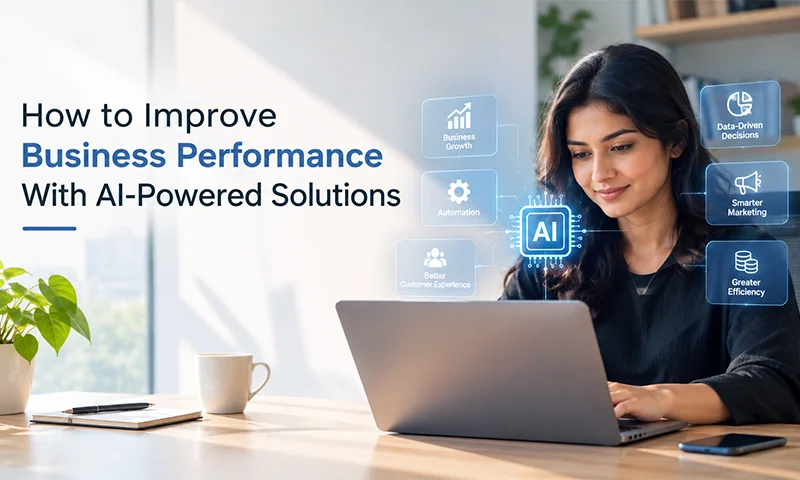
Improve Business Performance With AI-Powered Solutions
Artificial intelligence is no longer limited to large technology companies or complex research projects. Businesses of all sizes are using AI-powered solutions to improve everyday operations, understand customers, reduce repetitive work, and make better decisions. However, successful AI adoption starts with identifying where it can create genuine value. Instead of adopting AI simply because it is a growing trend, businesses should look at their existing challenges and determine which processes could become faster, smarter, or more efficient with the right technology.
Automate Repetitive Business Tasks
One of the most practical ways to improve business performance with AI is through automation. Many employees spend valuable time handling repetitive activities such as data entry, scheduling, document processing, responding to common questions, and preparing routine reports. AI-powered tools can handle many of these tasks with limited human involvement. This allows employees to focus more on creative thinking, problem-solving, customer relationships, and other responsibilities that require human judgment. As a result, businesses can improve productivity without unnecessarily increasing workloads.
Make Better Decisions With Business Data
Businesses generate large amounts of information through sales, customer interactions, websites, social media, financial transactions, and internal operations. AI can help turn this information into useful insights. AI-powered analytics tools can identify patterns, compare performance, detect unusual activity, and support forecasting. Instead of relying entirely on assumptions, managers can use data-driven insights when planning marketing campaigns, managing inventory, setting targets, or allocating resources. Better access to meaningful information can help businesses respond more quickly to changing market conditions.
Improve Customer Experience
Customer expectations are constantly changing, and businesses need to provide quick and convenient support. AI-powered chatbots and virtual assistants can answer frequently asked questions, provide basic product information, assist with bookings, and guide customers through simple processes. AI can also analyze customer behavior to help businesses understand preferences and identify areas where the customer experience can be improved. When automation is combined with human support, companies can offer faster service while still providing personal attention when a more complex issue requires it.
Strengthen Marketing and Sales
AI can also support marketing and sales teams by helping them understand audiences and create more targeted campaigns. Businesses can use AI to analyze customer behavior, identify potential leads, personalize communication, and evaluate campaign performance. AI tools can assist with generating content ideas, organizing customer information, and identifying patterns in sales data. These capabilities can help marketing and sales teams spend more time developing strategies rather than manually handling large amounts of information.
Reduce Operational Costs
Improving efficiency can have a direct effect on business costs. AI can help organizations identify unnecessary expenses, optimize workflows, improve resource planning, and reduce errors. For example, predictive systems can help businesses anticipate demand and manage inventory more effectively, while automated quality checks can identify problems earlier. Lower operational waste does not necessarily mean reducing staff. In many cases, it means allowing existing teams to use their time and resources more effectively.
Support Employees With Smarter Tools
AI should not be viewed only as a replacement for manual work. It can also become a useful assistant for employees. AI-powered tools can help professionals summarize information, organize documents, research topics, analyze data, and generate initial ideas. Giving employees access to these tools can reduce time spent on routine work and allow them to concentrate on tasks that require experience, creativity, communication, and critical thinking. Proper training is important so employees understand both the benefits and limitations of AI.
Protect Quality and Business Information
As businesses introduce AI, they also need to pay attention to accuracy, privacy, security, and responsible use. AI-generated information should not automatically be treated as correct. Important decisions should include appropriate human review, particularly when financial, legal, customer, or sensitive business information is involved. Companies should also establish clear rules about what information can be entered into AI systems and how that information should be protected. Responsible implementation helps businesses gain the advantages of AI while managing potential risks.
Start Small and Measure Results
Businesses do not need to transform every department at once. A better approach is to begin with one or two processes where AI can provide measurable improvements. Companies can test an AI solution, track results, collect employee feedback, and make adjustments before expanding its use. Useful measurements may include time saved, operating costs, customer satisfaction, productivity, response times, or sales performance. This practical approach makes AI adoption more manageable and helps businesses understand whether an investment is delivering meaningful results.
Build a Future-Ready Business
AI-powered solutions can become an important part of modern business strategy when they are introduced with a clear purpose. From automation and data analysis to customer service and marketing, AI can help organizations work more efficiently and respond to opportunities more quickly. The key is not simply using more AI, but using it thoughtfully. Businesses that combine technology with skilled employees, strong processes, and responsible decision-making can create a more efficient and adaptable operation prepared for long-term growth.